utorok 26. januára 2010

Merrill: Obama Just Triggered The Well-Overdue 'Wall St. Versus Main St. Correction'

Merrill: Obama Just Triggered The Well-Overdue 'Wall St. Versus Main St. Correction'

After China began tightening monetary policy faster than expected, Obama's sudden hard charge against U.S. banks was the straw that broke the market's back according to Bank of America Merrill Lynch. What we've witnessed with the recent market sell-off is the ultimate result of Wall St. diverging from Main St.:

Merrill: Wall Street (the equity market) and Main Street (the labor market) have diverged, and this cannot continue indefinitely. Financial sector policies have worked. Labor market policies have not. The biggest risk for 2010 bulls is that policy makers withdraw financial market stimulus via regulation, or raise rates before stimulus has had a chance to help the labor market and cause a double-dip.

chart

(Via Bank of America Merrill Lynch, "The Wall St. Vs. Main St. Correction")

Mean Street: Obama is Killing America by Killing Wall Street - Deal Journal - WSJ

Mean Street: Obama is Killing America by Killing Wall Street - Deal Journal - WSJ

What has become of America?

Today, Goldman Sachs CEO Lloyd Blankfein announced record annual profits of $13.4 billion for his bank.

He has repaid the U.S. taxpayer $11.42 billion for taking TARP money he didn’t want.

meanstreet

He will contribute another $6.4 billion in taxes to the general public.

And within weeks, if President Obama gets his way, Blankfein has a good shot at becoming the most hated man in our nation.

Apparently, this is now how we treat success in America. We damn it, and then we punish it by enacting loopy, politically expedient measures such as caps on Wall Street trading and principal investments.

Why is our country so self-destructive?

We need people to come together, but we engage in populist divisiveness. We need millions of jobs, but we kill the incentives and destroy the capital that will create them.

Please don’t accuse me of not “getting it.” I do “get it.” I “get” that Main Street is suffering. I “get” that Wall Street is full of selfish, greedy people. I “ get” that Wall Street engages in reckless trading. I “get” that no bank should be too big to fail.

But does anyone actually believe the new White House war on Wall Street will remedy any of that? I know I don’t.

This war is about politics. It’s about a big election loss in Massachusetts. It’s about pushing the blame for the nation’s misery from Washington onto Wall Street.

Is President Obama talking to Tora Bora terrorists or Park Avenue bankers when he says: “So if these folks want a fight, it’s a fight I’m ready to have.”

Unfortunately, it’s a fight — that at least on the PR front — Washington is already winning. Just read today’s subdued Goldman Sachs earnings release.

Total profits were a “record” at the bank, even if earnings per share weren’t. But you wouldn’t know that from the Goldman press release. Instead, the big PR highlight is “Compensation and Benefits Down By $4 billion or 20% From 2007. Lowest Annual Compensation.”

How perverse. Job creation in our economy comes from profits and growing incomes. But here is America’s best-run company almost ashamed of its profits and bragging about how much less it’s paying its people.

Make no mistake — this war will damage the nation’s psyche. Just look at today’s stock market. In fact, the war’s unforeseen consequences are just now beginning to appear .

It’s bound to get very, very messy because in fact, contrary to the President’s assertion, the 2008 collapse had little to do with the dissolution of Glass-Steagall or proprietary trading by banks.

Sure, Wall Street was way too vulnerable because it was way too leveraged.

But AIG wasn’t a bank. Neither Lehman Brothers nor Bear Stearns took consumer deposits. And the hundreds of billions in losses at Fannie Mae and Freddie Mac — as well as the destruction of Wachovia, Washington Mutual and Countrywide had nothing to do with prop trading.

That was caused by banks lending money to millions of Americans to buy houses they couldn’t afford. You won’t hear much of that coming from Washington. After all, “It’s Actually Your Fault, America” is not a good slogan for a re-election campaign.

The Obama-Volcker remarks in full

REMARKS BY PRESIDENT BARACK OBAMA

SUBJECT: ADDITIONAL REFORMS TO THE FINANCIAL SYSTEM

THE DIPLOMATIC RECEPTION ROOM, THE WHITE HOUSE, WASHINGTON, D.C.
11:39 A.M. EST, THURSDAY, JANUARY 21, 2010

PRESIDENT OBAMA: Good morning, everybody. I just had a very productive meeting with two members of my Economic Recovery Advisory Board: Paul Volcker, who is the former chair of the Federal Reserve Board, and Bill Donaldson, previously the head of the SEC. And I deeply appreciate the counsel of these two leaders and the board, that they’ve offered as we have dealt with a broad array of very difficult economic challenges.

Now over the past two years more than 7 million Americans have lost their jobs in the deepest recession our country has known in generations. Rarely does a day go by that I don’t hear from folks who are hurting. And every day we are working to put our economy back on track and put America back to work.

But even as we dig our way out of this deep hole, it’s important that we not lose sight of what led us into this mess in the first place. This economic crisis began as a financial crisis when banks and financial institutions took huge, reckless risks in pursuit of quick profits and massive bonuses. When the dust settled and this binge of irresponsibility was over, several of the world’s oldest and largest financial institutions had collapsed or were on the verge of doing so. Markets plummeted, credit dried up, and jobs were vanishing by hundreds of thousands each month. We were on the precipice — precipice of a second Great Depression.

And to avoid this calamity, the American people, who were already struggling in their own right, were forced to rescue financial firms facing crisis largely of their own creation. And that rescue, undertaken by the previous administration, was deeply offensive, but it was a necessary thing to do, and it succeeded in stabilizing financial systems and helping to avert that depression.

Since that time, over the past year, my administration has recovered most of what the federal government provided the banks. And last week I proposed a fee to be paid by the largest financial firms in order to recover every last dime.

But that’s not all we have to do. We have to enact common-sense reforms that will protect American taxpayers and the American economy from future crises as well.

For while the financial system is far stronger today than it was one year ago, it’s still operating under the same rules that led to its near collapse.

These are rules that allowed firms to act contrary to the interests of customers, to conceal their exposure to debt through complex financial dealings, to benefit from taxpayer-insured deposits while making speculative investments, and to take on risks so vast that they posed threats to the entire system. That’s why we are seeking reforms to protect consumers.

We intend to close loopholes that allowed big financial firms to trade risky financial products, like credit-default swaps and other derivatives, without oversight; to identify system-wide risks that could cause a meltdown; to strengthen capital and liquidity requirements, to make the system more stable, and to ensure that the failure of any large firm does not take the entire economy down with it.

Never again will the American taxpayer be held hostage by a bank that is too big to fail.

Now, limits on the risks major financial firms can take are central to the reforms that I have proposed. They are central to the legislation that has passed the House, under the leadership of Chairman Barney Frank, and that we’re working to pass in the Senate, under the leadership of Chairman Chris Dodd.

As part of these efforts, today, I’m proposing two additional reforms that I believe will strengthen the financial system while preventing future crises.

First, we should no longer allow banks to stray too far from their central mission of serving their customers. In recent years, too many financial firms have put taxpayer money at risk by operating hedge funds and private equity funds and making riskier investments, to reap a quick reward.

And these firms have taken these risks while benefitting from special financial privileges that are reserved only for banks. Our government provides deposit insurance and other safeguards and guarantees to firms that operate banks.

We do so because a stable and reliable banking system promotes sustained growth and because we learned how dangerous the failure of that system can be during the Great Depression. But these privileges were not created to bestow banks operating hedge funds or private equity funds with an unfair advantage.

When banks benefit from the safety net that taxpayers provide, which includes lower-cost capital, it is not appropriate for them to turn around and use that cheap money to trade for profit. And that is especially true when this kind of trading often puts banks in direct conflict with their customers’ interests.

The fact is, these kinds of trading operations can create enormous and costly risks, endangering the entire bank if things go wrong.

We simply cannot accept a system in which hedge funds or private- equity firms inside banks can place huge, risky bets that are subsidized by taxpayers and that could pose a conflict of interest. And we cannot accept a system in which shareholders make money on these operations if a bank wins, but taxpayers foot the bill if a bank loses.

It’s for these reasons that I’m proposing a simple and common- sense reform, which we’re calling the Volcker rule, after this tall guy behind me. Banks will no longer be allowed to own, invest or sponsor hedge funds, private-equity funds or proprietary trading operations for their own profit, unrelated to serving their customers. If financial firms want to trade for profit, that’s something they’re free to do. Indeed, doing so responsibly is a good thing for the markets and the economy. But these firms should not be allowed to run these hedge funds and private equities — funds while running a bank backed by the American people.

In addition, as part of our efforts to protect against future crises, I’m also proposing that we prevent the further consolidation of our financial system. There has long been a deposit cap in place to guard against too much risk being concentrated in a single bank. The same principle should apply to wider forms of funding employed by large financial institutions in today’s economy. The American people will not be served by a financial system that comprises just a few massive firms. That’s not good for consumers; it’s not good for the economy. And through this policy, that is an outcome we will avoid.

And my message to members of Congress of both parties is that we have to get this done. And my message to leaders of the financial industry is to work with us, and not against us, on needed reforms. I welcome constructive input from folks in the financial sector. But what we’ve seen so far in recent weeks is an army of industry lobbyists from Wall Street descending on Capitol Hill to try and block basic and common-sense rules of the road that would protect our economy and the American people.

So if these folks want a fight, it’s a fight I’m ready to have. And my resolve is only strengthened when I see a return to old practices in some of the very firms fighting reform; when I see soaring profits and obscene bonuses at some of the very firms claiming that they can’t lend more to small businesses, they can’t keep credit- card rates low, they can’t pay a fee to refund taxpayers for the bailout without passing on the cost to shareholders or customers. That’s the claims they’re making.

It’s exactly this kind of irresponsibility that makes clear reform is necessary.

Now, we’ve come through a terrible crisis. The American people have paid a very high price. We simply cannot return to business as usual. That’s why we’re going to ensure that Wall Street pays back the American people for the bailout. That’s why we’re going to rein in the excess and abuse that nearly brought down our financial system. That’s why we’re going to pass these reforms into law.

Who Bears the Costs of Post-Crisis Recovery ?

Who Bears the Costs of Post-Crisis Recovery ?: "

For over a year now, I have been advocating a Swedish rather than Japanese approach to crisis. The Swedes decided to protect their banking system at all costs; the Japanese protected their banks at all costs.

That subtle distinction is the difference between a rapid recovery and a slow, agonizing one.

Some people think this is an academic debate — a distinction without a difference. However, when you see who bears where the actual costs of this fall, it is apparent that the it is an enormous difference.

Unfortunately, the US (mostly) went the Japanese route. Exceptions are the automakers and a handful of FDIC closed banks. Instead of waxing philosophical, let’s look at who pays the costs of this – and who does not.

Shareholders: In the Swedish approach, the Shareholders get wiped out. In the US/Japanese model, they take a big hit — a loss of 90%+ of their value — but they got to keep there stock shares. Hope springs eternal for an eventual recovery.

On Wall Street, other than Lehman Brothers (LEH), all other shareholders were saved. Bear Stearns (BSC), Citigroup (C), Fannie Mae (FNM), AIG, BofA, (BAC) Goldie (GS), Morgan Stanley (MS) — all were kept afloat.

Ironically, the insolvent firms that were forced into a reorganization – GM & Chrysler, Washingon Mutual, etc. – actually are the ones following (at least partially) the Swedish style model: Restructure, Wipe Out Debt, Recapitalize, Relaunch as a new, clean firm.

Bondholders: There are 3 parties that undeservedly were bailed out, and the head of the class are the bondholders.

Except for Lehman and FDIC closures, most bondholders were rescued: Bear Stearns Bondholders received 100 cents on the dollar — that was their reward for exercising terrible judgment when lending money to a reckless irresponsible insolvent investment house (so much for Moral Hazard). Same for Citi, Fannie Mae, Bank of America. We still don’t know what the final impact will be for AIG Bondholders, but expectations are for the full monty.

When future historians discuss the bailouts of 2008-09, and discuss who were the greatest financial recipients of taxpayer largesse, they will be referring to the bondholders.

Counter-parties: For reasons not yet explained, Paulson, Bernake and Geithner essentially gifted to speculators and hedge fund traders a guarantee that all their back alley bets would be made good. This is truly perplexing, as they are probably the least deserving group receiving taxpayer money.

Management: Several senior execs have lost their jobs, but they have been the exception. A recent study found that 92% of TARP firm senior execs, boards of directors, and C-level management were still running the firms they had been. It is perplexing to those of us are trying to figure out the penalties for driving your firm over a cliff . . .

Taxpayers: So far, the US taxpayer has laid out all of the costs of the bailouts. TARP appears to be mostly repaid, and the new TBTF tax should recover the rest. But the question the FCIC should be asking is why are taxpayers a backstop fro traders and speculators?

Borrowers: Banks are lending dramatically less, as they slowly recapitalize their balance sheets, borrowing from the Fed at 0% and lending back to the Treasury at 3%. Best guesses are that this year and last will see a $1 trillion less dollars than normally would be loaned to credit worthy borrowers. This is directly due to the Japanese approach that allows bad balance sheets and enormous bank under-capitalization to continue.

Workers: Are going to suffer for a long period of slow job recovery due to the above. If banks were forced into the normal FDIC insolvency process, the economy and employment would likely recover must faster.

Savers: Zero % interest rate. Estimates are this costs depositors $250Billion per year. ’nuff said

Bank Customers: All banks customers are now buying services from frims in a sector with much less competition.

First Time Home Buyers: Although they get a minor tax credit, various government policies are maintaining home prices at levels far in excess of where the market would take them. Outside of the big foreclosure zones, they are feeling the impact of the subsidies and bad policies.

The bottom line: Bailouts have specific winners and losers . . .

Previously:

Attack of the Zombies ! February 26th, 2009
http://www.ritholtz.com/blog/2009/02/attack-of-the-zombies/

92% of TARP Firm Sr Management is Unchanged (January 4th, 2010)
http://www.ritholtz.com/blog/2010/01/banking-sector-remains-literally-unchanged/

See also:

What we can learn from Japan’s decades of trouble

Martin Wolf

FT, January 12 2010
http://www.ft.com/cms/s/0/3c5b388e-ffb2-11de-921f-00144feabdc0.html

"

pondelok 18. januára 2010

Lost decade with Dylan Grice

Analyst Dylan Grice produces really good reports. I think Japanese lost decade is his obsession, but honestly, who's isn't :)

His first report I have ever seen is called "The lesson from Japan? China will be the biggest bubble the world has seen."

Because its not uploaded on scribd, I will just post here the first page and you can download the rest here:


Studying the lessons from Japan’s lost decade(s) is key for anyone seeking to understand today’s post-bubble world. But a closer reading of Japan’s financial history illuminates today’s China far more. In the early 1980s, on the eve of its financial liberalisation, Japan was the rising power from the East set to overtake the West. Younger and growing rapidly, it was still a decade away from its climactic and catastrophic bubble peak. This is where China is now.

  • Japan’s deflationary experience since its bubble burst haunts policy makers and investors, who are confronted with a bewildering range of theories explaining what has gone wrong and how a similar scenario can or can’t be avoided.
  • But the real cause of Japan’s deflation is probably more demographic than debt-related. If so, maybe we should be more worried about the side-effects of an ongoing stimulus overdose aimed at reviving the dead, rather than fighting a more ordinary bout of flu.
  • Japan has been the first industrial economy to begin demographic contraction. Indeed, thanks to Deng Xiaoping’s 1979 one child policy, China will soon face the same problem.
  • But it is unlikely China will suffer the same immediate fate. In fact, further reflection on the similarities between China and Japan leads one to realise that many of the challenges confronting China today have already been faced by Japan, demography being only one.
  • From the strained currency diplomacy to the accusation of favouring exports over domestic demand, from the Western marvelling at Confucian capitalism to the sense of inevitability about the rising of a great power in the East … all were as true for Japan 30 years ago as they are of China today.
  • And Japan 30 or so years ago might be a more fruitful analogy altogether. There is a clear historic coincidence of manias and geopolitical shifts. In the 1980s, Japan’s developing financial bubble reflected a shifting of the balance of power in its direction.
  • But the geopolitical shift towards China now underway dwarfs that seen in Japan in the 1980s, and probably anything yet seen in the history of the modern world. A commensurately seismic mania would lead to excesses beyond all proportion to the periodic bouts of frothiness seen so far.
  • Japan’s experience also hints at what may be the future catalyst unleashing this frenzy: capital account liberalisation. Financial history is filled with financial liberalisations gone wrong and Japan’s bubble can be traced directly to the removal of controls on international capital flows and banking in the early 1980s. Seeking a larger international role for the renminbi, China is now, albeit tentatively, embarking on a similar path. Full liberalisation, when it occurs, could be the starting gun for the biggest bubble the world has ever seen.

His newest report "A global fiasco is brewing in Japan" continues on this topic and its a must-read too. Enjoy.


A Global Fiasco is Brewing in Japan (SocGen)

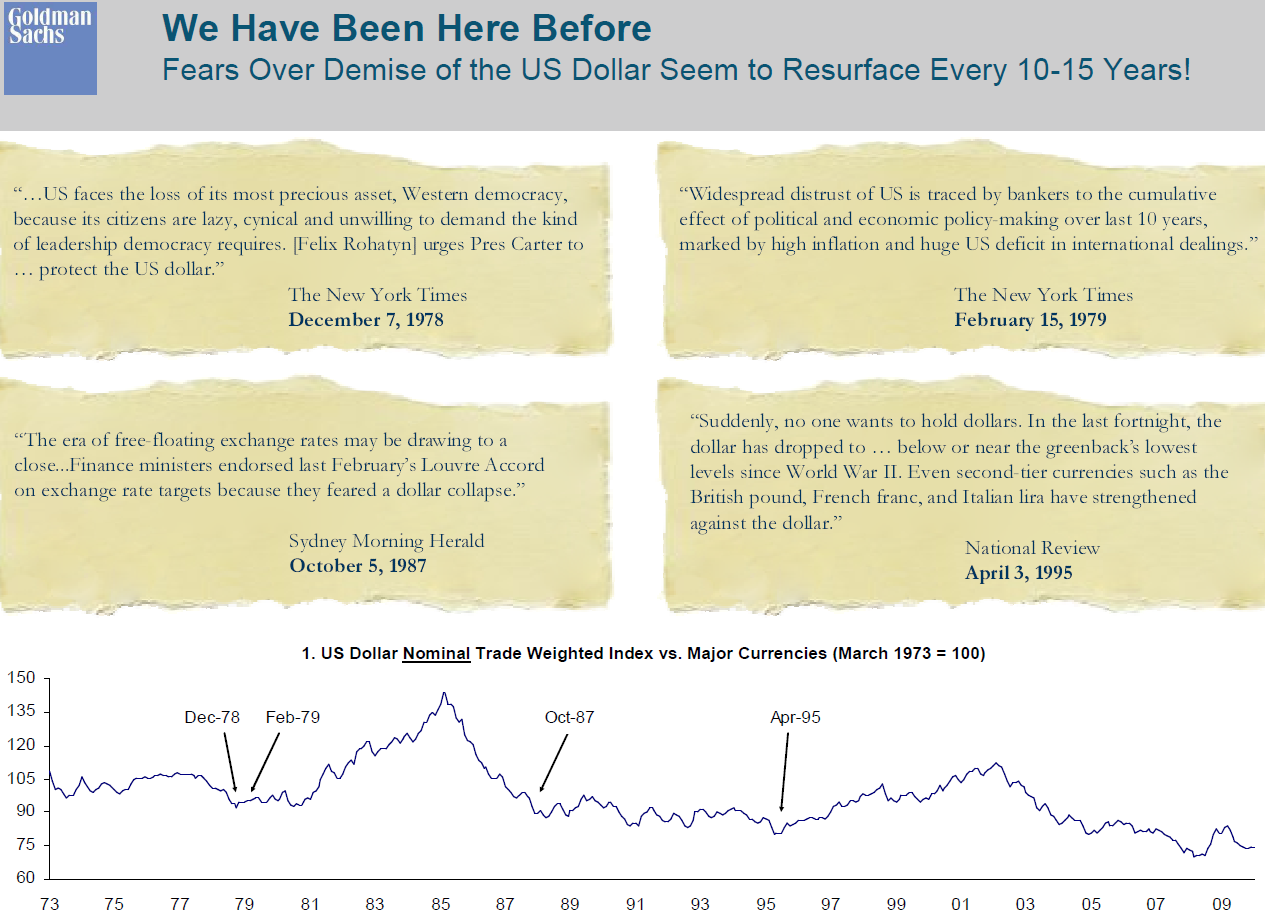
Fears Over US Dollar Resurface Every 10-15 Years

Fears Over US Dollar Resurface Every 10-15 Years: "

click for ginormo graphic


Source: Investment Strategy Group, Federal Reserve


Note: This material represents the views of the Investment Strategy Group of the Investment Management Division of Goldman Sachs and is not a product of the Goldman

Sachs Global Investment Research Department.

"

Transition Times :: Transition Times » Blog Archive » The End of Retirement

Transition Times :: Transition Times » Blog Archive » The End of Retirement: "

The End of Retirement

by André Angelantoni, PostPeakLiving.com)

“When do I call my children home?”

My friend asked me that question two years ago after I gave him a thorough explanation of what the decline of oil production meant for our civilization. Like many modern parents, his children were spread around the continent, or traveling the world, and he could instantly see how important his family working together was going to be in the future.

His question is a very good one and represents one way we might all want to consider relating to The Long Descent.

Before discussing that, a small detour is in order. I’ve used John Michael Greer’s label “The Long Descent” for this essay to make a point. In his book by the same name, Greer describes how civilizations tend to take decades if not centuries to descend from the pinnacle of their size to the point the last cities are abandoned to the jungle (in the case of the Mayans). Greer convincingly uses history to show that civilizations rarely if ever end by a catastrophic and instant collapse of all their systems at the same time. Instead, they experience mini-collapses followed by stasis or even some recovery. After reading his theory of catabolic collapse, I’ve modified my Staircase Model to include more steps after the big step in the middle:

staircasemodel


Though Greer and I are now aligned on the likely way our civilization will decline as we lose access to energy-dense fossil fuels, Greer’s especially is the long view. He is looking out tens and possibly hundreds of generations. With this long timescale, there is a danger in allowing the term “The Long Descent” to lull us into thinking we have more time than we do for certain preparations. This would be unfortunate because we have several challenges that won’t take generations to arrive. One significant and early challenge is already upon us.

The End of Retirement

Only 120 years old and widely available to the middle class for just the last 60 or so years, retirement is coming to an end. It is the unique product of several converging factors. The first was energy abundance in the form of fossil fuels, which allowed an ever-decreasing number of people to work the land to produce food for those that lived in the cities. Elevating great numbers of people above the daily grind of subsistence farming was necessary before the next factor could arise.

The second factor was the creation of a financial system that enabled us to “bank” future personal resource exploitation in the form of money. Online retirement calculators tell us how much money we need to retire but that money is clearly a proxy for the world’s resources. It would be impractical for the calculator to advise us to stockpile “2000 board-feet of wood for a new house, 20 lb of uranium for electricity and 400 gallons of jet fuel for foreign vacations.” Instead, it tells us to store money that we will in the future convert to resources. Once we have a nice stockpile of dollars or euros, the idea is to draw it down by converting it to foreign vacations (which are energy hogs, using in one or two weeks the amount of energy used by someone traveling by car for an entire year — simply because the destinations are often thousands of miles away), nice dinners (which bring an astonishing array of foods from around the world to an area no bigger than a dinner plate) and the occasional financial bailout of one’s children when they run out of money on a round-the-world trip.

Both of these factors are in the process of disappearing. We are not experiencing the popping of a short-term economic bubble like the tech boom or the tulip mania of several centuries ago. After this popping, there will be no significant recovery.

We now can see that the entire economy is a giant bubble that was inflated when we discovered the fossil fuel energy jackpot. Had we not found these fuels, world economic growth would surely have slowed or even reversed when we began to run out of trees to cut down some 200 years ago. (I show in my video “Preparing for a Post Peak Life” why renewable energy sources can’t even begin to make up for the loss of fossil fuels and especially oil; I won’t go into it here.)

To permit the economic bubble to expand at will, we severed the connection between money and the physical world. Money today has no physical backing. I can’t go to the issuer of the the U.S. dollar, the United States government, and trade it for gold, or silver or even beans. Without the anchoring constraint of tying paper currencies to the physical world, all forms of virtual wealth, of which money is just one form, have been allowed to increase beyond imagination. The hundreds of trillions in derivatives are the culmination of this process.

We now find that there is currently more money in existence than the world’s resources can support — especially oil. Oil is particularly important because as a fantastically energy dense and portable energy source it is what I call an “enabling resource.” In other words, it enables us to get all the other resources upon which we depend. True, we could over time switch to electricity powered by wind or coal, but many societal functions become more expensive, more time consuming and often impossible. For instance, mining an important mineral in a remote location is significantly more difficult if instead of simply transporting the energy to run the mining equipment by tanker truck the mining company has to run long distance electric wires or set up a small coal-fired electric plant. Portable, liquid fuel has allowed and accelerated our growth, and the impact has been like a cannon ball shot from a cannon.

Jeffrey Brown, who is a colleague and tireless educator on the matter of declining net oil exports, points out the connection between oil and money by asking this incisive question:

“What value do the ten largest banks in the world have if we take away the ten largest oil fields?”

The answer of course is “almost nothing.” Without energy, the money controlled or lent by the banks literally wouldn’t be able to do anything, including creating profit. Take away energy, world economic growth reverses and the value we’ve assigned in the current system (i.e. stock prices, future pension obligations, etc.) dramatically drops in value.

What does this mean for the relatively short-lived phenomenon of retirement? It means that whatever virtual assets you have accumulated over a lifetime of work — the money, stocks, bonds, real estate and the pensions made of those financial instruments — are headed for a massive devaluation. There are several ways it could happen. In response to the end of growth and with no physical constraint on printing money (because the link to the physical world is now gone) governments might hyperinflate their currencies as they struggle with debt they can no longer pay back. They should actually be doing exactly the opposite: the should remove money as the world economy contracts to return a balance between money and the resources implicitly backing the money. Alternatively, we could experience a fiat currency collapse, or bank runs, or a plunge in the stock market when one day a large enough group of people loses confidence in the system. Any one of those events could trigger the big step shown in the Staircase Model.

However the method, the devaluation must happen as energy is removed from the world economy. If you can’t yet see what I’m pointing to, keep pondering Jeffrey’s question as you move through the world. See how energy, particularly oil, is used to manufacture and transport every good and provide every service. Then take away the energy or make it very, very expensive. Does the economy expand or contract? Do assets increase in value or decrease in value? Which ones? Eventually you will see the connection between oil and money. As oil goes, so does money — and your retirement assets.

Is there still some time before this devaluation occurs? Yes, but just how long is impossible to predict with accuracy. Personally, I can’t see the system holding up much beyond this decade (i.e. up to 2020), but reasonable, intelligent people will provide different answers to this question.

Turning Virtual Assets to Real Assets

The stockpile of virtual assets that many of us relied on drawing down during retirement is already losing value; that process will accelerate. It’s time to put that value to use before it disappears entirely.

In my courses the hardest thing for people to do is act on this insight, for many reasons. It might mean giving up on dreams of endless travel and golf games. It might mean their children do not go to college. It definitely means preparing for a very different life. Regardless of the reason, I always encourage people to summon the courage to act. In particular, I recommend that people start converting their virtual assets to real assets (i.e. physical things) while the virtual assets still have value. Timing these conversions well means getting more real assets in exchange for the virtual assets but how long to wait before one is mostly out of the virtual asset game is a matter of personal tolerance for risk.

It takes time to get ready for the end of retirement. Products that are easy to obtain now will be difficult or impossible to obtain outside of the black market (if at all). There are new skills to learn, like learning to grow food, or some other skill that can be traded for food. Homes need to be retrofitted to use the least possible energy and, where there is sufficient money, to produce energy. Then there is the very real challenge of being set up properly to pay property taxes and possibly a mortgage year after year (or the rent, if one doesn’t own one’s shelter). Families will do better if their members live close to each other and especially in the same house to help pay for common expenses. I know of several families making plans to move close to each other right now.

After a close look, most people eventually see that they are perfectly capable of running a post peak household once the need for iPods and foreign vacations goes away. But that doesn’t mean that setting up for The Long Descent can be done overnight. I would say a full third of the people in my courses have already been diligently at work for years.

If Iraqi oil buys us a few more years, we should count ourselves lucky but it is far from guaranteed that Iraqi oil will come online quickly enough and in sufficient quantity to make a significant difference. In other words, don’t put off preparing or — even worse — think The Long Descent has been avoided. This is especially true if you see yourself, as my friend does, one day calling your children, taking a deep breath and quietly but purposefully saying, “I think it’s time for you to come home.”

"